
October 8, 2026
Is roughcasting worth it? See how this durable exterior finish protects Scottish homes, what affects the cost, and whether repair is enough for you...

Leaves do not need to fill a gutter completely to cause a problem. A small build-up around an outlet can hold back rainwater, sending it over the gutter edge and down external walls. For homeowners comparing the best gutter guards UK suppliers offer, the right answer is usually not the product with the boldest claim. It is the guard that suits the roof, the gutter profile, the surrounding trees and the weather your property faces.
In Central Scotland, gutter protection has to cope with frequent rain, wind-blown debris, moss from tiled roofs and, in many areas, mature trees close to homes. A poorly chosen guard can reduce cleaning for a while but make drainage worse during a heavy downpour. Getting the basics right matters more than buying the most expensive option.
A gutter guard should keep out the debris that causes blockages while allowing rainwater to enter freely. That sounds simple, but the design must also handle the speed at which water runs off the roof. During a Scottish downpour, water can flow over tiles or slates quickly. If the guard is too flat, too fine, poorly angled or installed below the roof edge, water may shoot past it rather than into the gutter.
The best systems also allow for sensible maintenance. No gutter guard makes a roof completely maintenance-free. Fine organic material, moss and seeds can settle on top of any cover, especially beneath overhanging trees. A good installation makes that debris easy to brush away and still allows access to the gutter when inspection or cleaning is needed.
Before fitting anything, check that the existing gutters are secure, correctly aligned and draining towards the outlets. Guards cannot compensate for loose brackets, a backfall in the gutter, cracked joints or a blocked downpipe. In some cases, repairing or renewing the guttering will solve the issue more effectively than adding a cover.
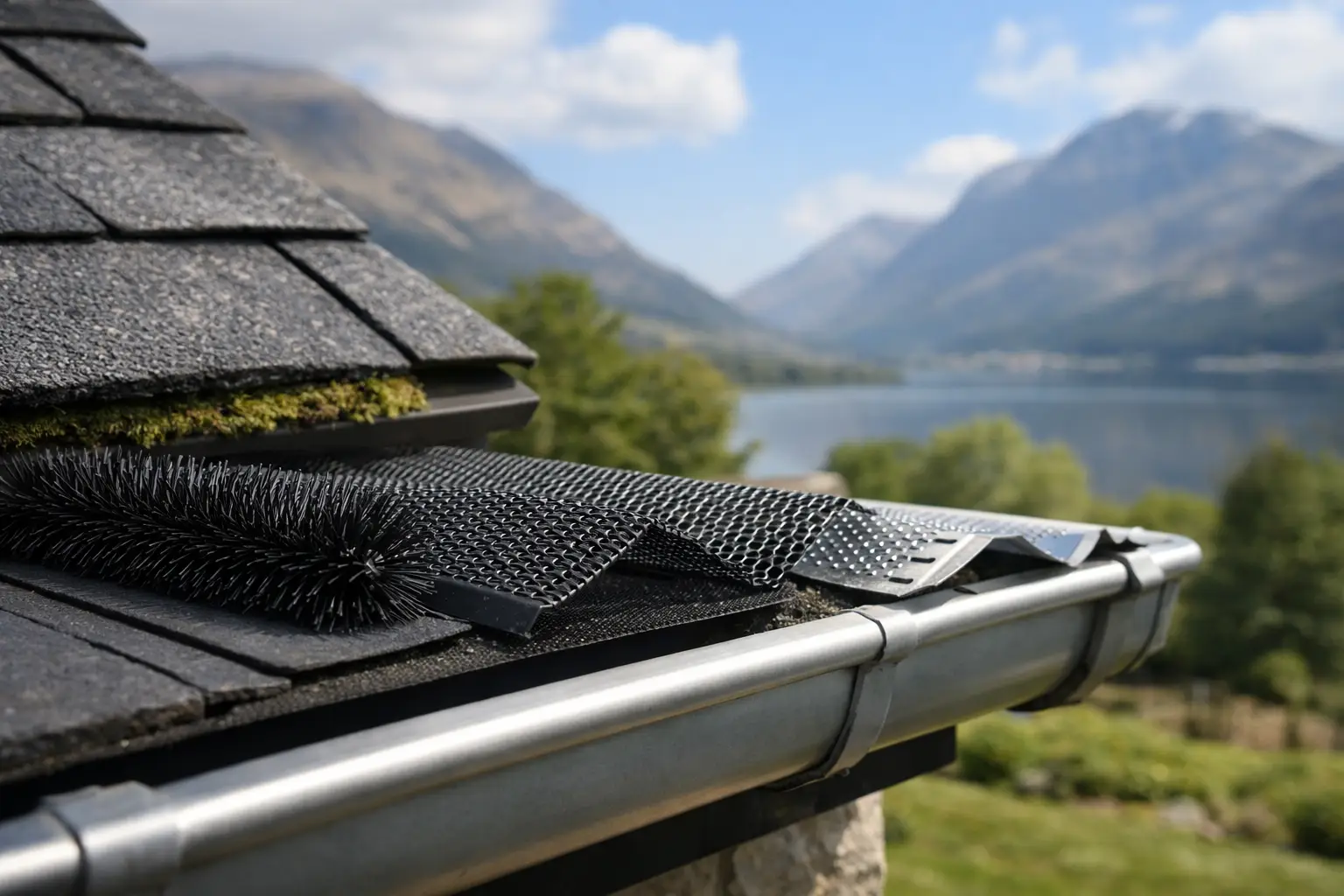
Micro-mesh guards are often the strongest all-round choice for homes dealing with leaves, pine needles, moss and smaller debris. Their fine screen sits across the gutter and stops most material entering while water passes through. Quality metal mesh is more durable than lightweight plastic and is less likely to sag, crack or become brittle over time.
This type works particularly well where gutters are regularly affected by moss dropping from an older tiled roof. It can also be a sensible option beneath trees with small leaves or needles, where wide plastic grids may allow too much material through.
There is a trade-off. Very fine mesh needs to be fitted at the correct angle and kept clear on its upper surface. Moss and fine debris can form a layer on top, reducing water flow if it is ignored for years. It is therefore best for properties where someone can safely carry out occasional checks, or where professional gutter maintenance is arranged.
Plastic mesh guards are widely available and can be a budget-friendly option for straightforward gutters with moderate leaf fall. They are usually easy to fit and remove, making them useful where access is safe and the guttering is in good condition.
Their weakness is long-term durability. Cheaper plastic can warp under sun and frost, loosen in high winds or become brittle with age. Some clip-in designs also sit awkwardly in certain gutter profiles, leaving gaps at the edges or restricting the flow into the gutter. They can be worthwhile on a low-risk property, but they are rarely the best fit for exposed homes or gutters that already have drainage issues.
Brush guards sit inside the gutter and look rather like long bottle brushes. Water flows through the bristles while larger leaves rest on top or catch within them. They are quick to install and do not usually require altering the roof edge or fascia.
However, they tend to collect moss, small leaves and gritty sediment within the brush itself. Once packed with debris, they can hold water in the gutter rather than keeping it clear. For that reason, brush guards are better viewed as a short-term or light-debris solution, not a fit-and-forget answer for heavily treed gardens.
Foam gutter inserts fill the gutter channel while allowing water to pass through their porous surface. They are simple to install, but they can trap fine silt and organic matter and may degrade over time. On a roof that sheds moss, the pores can become blocked surprisingly quickly.
They are generally not our first recommendation for long-term protection in wet, leafy parts of Scotland. A foam insert can also make it harder to spot gutter deterioration beneath it, which is not ideal on older properties.
Solid gutter covers use a shaped front edge to guide rainwater into the gutter while leaves and debris pass over the top. A well-designed, professionally fitted system can be effective, especially for larger leaves. Because the gutter is covered, it can look neat and may reduce the amount of material settling inside.
The installation is more specialised, and performance depends heavily on the roof pitch, tile or slate edge, gutter position and rainfall intensity. A cover that works well on one roof can overshoot during heavy rain on another. These systems also cost more and should not be fitted over tired guttering without addressing the condition of the fascia, brackets and outlets first.
The most useful question is not, “Which gutter guard is best?” but, “What is getting into my gutters?” Large broad leaves call for a different solution from pine needles, roof moss or loose grit from ageing mortar.
If leaves are the main issue, a durable mesh or solid cover may reduce cleaning significantly. If moss is the main culprit, roof maintenance and a quality micro-mesh guard are often a better combination. Where the blockage is actually caused by sagging gutters, poor falls or undersized outlets, gutter repairs should come before guards.
Properties near woodland, or homes with gutters beneath large trees, should also consider access. Even the best guard will need periodic checks after autumn storms. If safe access requires ladders, it is better not to turn this into a risky DIY job. Water damage from overflowing gutters is inconvenient; a fall from height can be far more serious.
A gutter guard should be fitted without lifting or damaging roof tiles, forcing the gutter out of shape or blocking the flow at outlets. The guard needs to sit securely enough to withstand wind but should remain removable for cleaning and inspection.
Pay attention to gutter valleys, corners and downpipe outlets. These are natural collection points for debris and often need a tailored approach rather than a continuous strip of guard. It is also worth checking whether the roof has bird guards at the eaves, as these can affect how a gutter cover is fitted.
On older homes, the condition of UPVC fascia boards, timber fascias and gutter brackets should be assessed at the same time. A guard adds a little weight and catches wind-driven debris, so loose or decaying fixings should not be overlooked. Good drainage starts with sound, correctly pitched guttering.
If you can see water overflowing, staining on render, damp patches near the roofline or vegetation growing from the gutter, arrange an inspection and clean before installing guards. Fitting a cover over existing debris simply hides the blockage.
Likewise, if water is spilling at one joint or running behind the gutter, the problem may be a failed seal, a misaligned section or damaged fascia rather than leaves. Repairs may be modest when dealt with early, whereas repeated overflow can affect brickwork, render, soffits and the ground around the property.
For landlords and property managers, a planned maintenance visit can be more predictable than reacting to tenant reports after every severe storm. It provides a chance to clear gutters, inspect roof edges and identify small defects before they become a leak.
For many homes, a professionally fitted metal micro-mesh guard offers the best balance of debris protection, water flow and service life. It is not automatically right for every property, but it is usually more dependable than foam or brush inserts where moss and fine debris are common. The final decision should follow an honest look at the roof, gutter condition, tree cover and access requirements.
Forth Valley Roofing can inspect gutters, roof edges and drainage issues before recommending whether guards, repairs or a full gutter clean will give the best value. A clear gutter is only useful when the water has somewhere sound to go, so dealing with the whole system is the sensible way to protect your home through the next spell of heavy rain.
Is roughcasting worth it? See how this durable exterior finish protects Scottish homes, what affects the cost, and whether repair is enough for you...

See a gutter replacement project example, from the first inspection to fitting new gutters, and learn what protects a Central Scotland home in winter.

Does roof ventilation reduce condensation? Learn when roof vents help, what causes loft moisture and how to protect your Central Scotland home this winter.